Eye-Tracking Lab at SDSU: Exploring the Future of News Literacy, Advertising and Media Behavior
San Diego State University’s cutting-edge Eye-Tracking Lab is a nexus of interdisciplinary research, providing unprecedented insight into the human mind and behavior and dedicated to advancing our understanding of how people engage with digital media.
Housed on the fourth floor of Adams Humanities (AH) in the School of Journalism & Media Studies (JMS), the Lab is equipped with new, state-of-the-art high-speed, precision hardware that captures real-time visual attention and cognitive processing with millisecond accuracy.
Founded by Dr. Arthur D. Santana with support from the Campanile Foundation, President’s Leadership Fund and the College of Professional Studies and Fine Arts (PSFA), the Lab leverages state-of-the-art eye-tracking technology to explore the evolving relationship between readers and news and advertising content.
JMS’ recent acquisition of the Tobii Pro Fusion, a screen-based system that supports both fixation and saccade-based studies and capturing gaze data at 250 Hz, positions the Lab on the leading edge of discovery. The ruler-sized hardware uses two cameras and supports both bright and dark pupil tracking, ensuring robust data collection across participant demographics.
The Lab provides faculty and students with the advanced tools to transform raw gaze data into actionable, evidence-based insights, solidifying SDSU’s position at the forefront of behavioral science and innovation.
Research Focus and Impact
Since its inception, the Lab has produced innovative research that sheds light on the digital disruption facing journalism today:
- News Literacy & Visual Cues: The research revealed that readers often overlook visual indicators distinguishing opinion pieces from news articles, raising critical questions about the role of design in public confusion over journalistic content.
- Online Incivility & Personality: Inquiring into the civility of online news commenting forums, and in collaboration with JMS alum Dr. Toby Hopp at the Univ. of Colorado Boulder, this research uncovered how personality traits may influence a reader’s attraction to uncivil discourse.
- Social Media & Attention: This groundbreaking research, envisioned by JMS grad student Bridget Cole, examined how browsing TikTok affects news engagement. Findings showed that those who browsed TikTok before reading were significantly less attentive to news articles—especially those with low habitual news consumption.
Expanding the Research Horizon
The Lab continues to grow as a hub for interdisciplinary inquiry, bringing together cognitive science and attentional behaviors in the area of advertising and journalism. JMS Professors Dr. Xiaohan (Catherine) Hu and Dr. Jiyoon (Karen) Han are currently working with Dr. Santana on projects that explore:
- The impact of deepfake disclosures in advertising on viewer perception.
- How readers notice and respond to the race and ethnicity of journalists, and whether such recognition affects perceived news credibility.
Vision for the Future
Looking ahead, JMS envisions the Eye-Tracking Lab as a world-class facility—fully modernized and equipped to lead national research efforts in media behavior. With newly upgraded equipment and expanded research space, the lab aims to deepen its thematic focus on digital disruption, audience engagement and the psychological dimensions of news consumption.
By fostering interdisciplinary collaboration and producing actionable insights, the Eye-Tracking Lab is not only shaping the future of journalism and advertising education at SDSU but also contributing to broader efforts to understand and improve the public’s relationship with media in a rapidly evolving digital landscape.
For more information about the Lab, please contact Rafael Avitabile or Dr. Arthur Santana.
SDSU students interested in participating in research studies, can learn how to sign up here.
How it works:
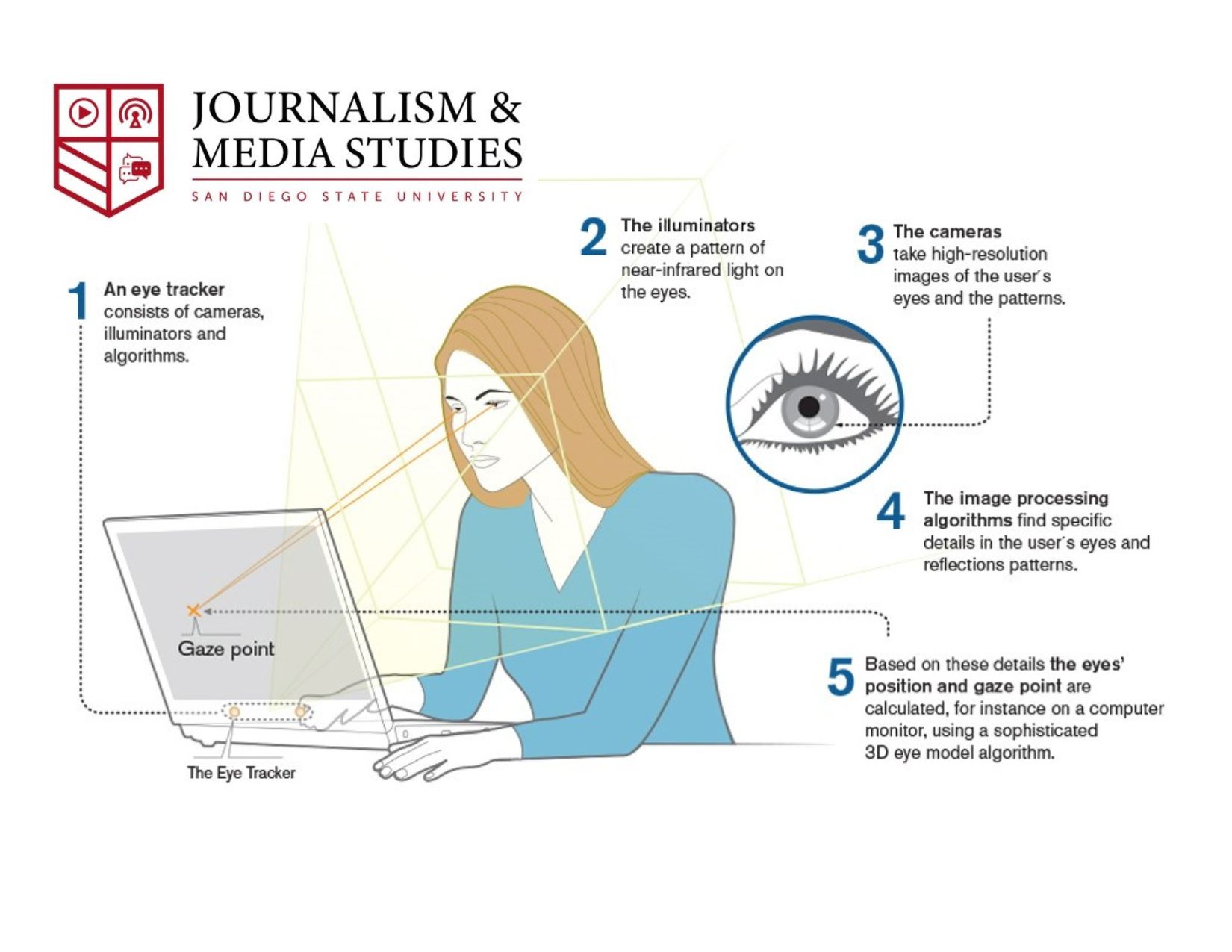
Gaze Plots and Heat Maps
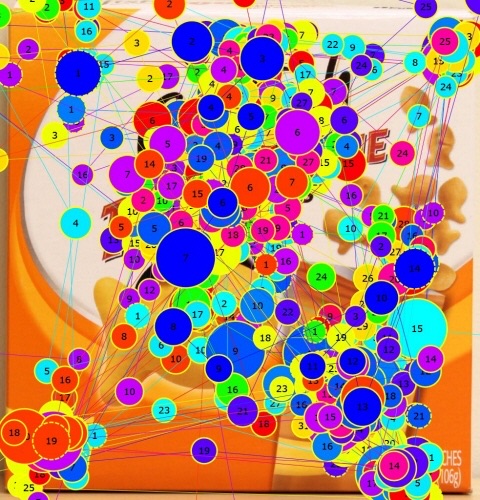
The Tobii technology allows researchers to generate heat maps and gaze plots that can communicate important aspects of visual behavior.
Gaze plots show the location, order and time spent looking at specific locations on the stimuli, whether a web page, advertisement or video. Thousands of data points are then analyzed for patterns and behaviors.
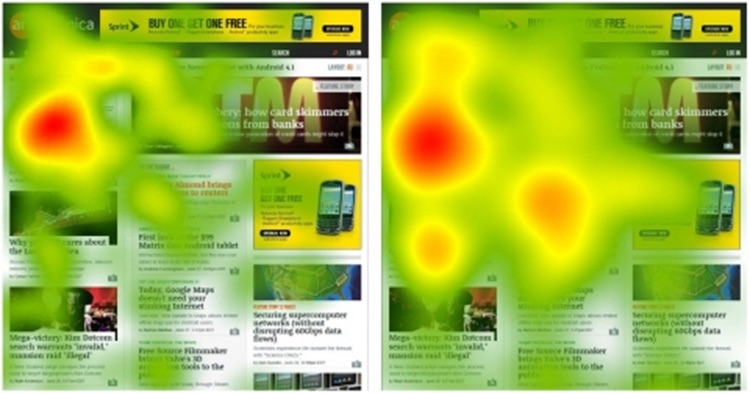
Heat maps offer a visual demonstration of how attention is distributed over a stimuli and can effectively reveal the focus of visual attention for more participants at a time.
In the News
A new SDSU study led by journalism graduate Bridget Cole found that even five minutes of TikTok use can disrupt focus when reading long-form content. Eye-tracking data from 242 students showed that those who scrolled the app before reading news articles scanned text more rapidly and with less sustained attention than those who didn’t. The findings support research suggesting that short-form, reward-driven content makes it harder for the brain to shift into deeper reading, underscoring how scrolling between study sessions may unintentionally hinder concentration.
An SDSU eye-tracking study found that even a few minutes of TikTok use can disrupt readers’ focus. Participants who scrolled the app before reading news articles were more likely to skim quickly between paragraphs and images, suggesting reduced immersion and difficulty concentrating. The research adds important evidence to conversations about how social media shapes attention and information processing.