JMS students take center stage at Institute for Public Relations conference
JMS graduate students presented original public relations research on AI ethics, trust and internal influencers at the IPR Bridge Conference, gaining professional validation, industry connections and deeper insight into the field’s future.
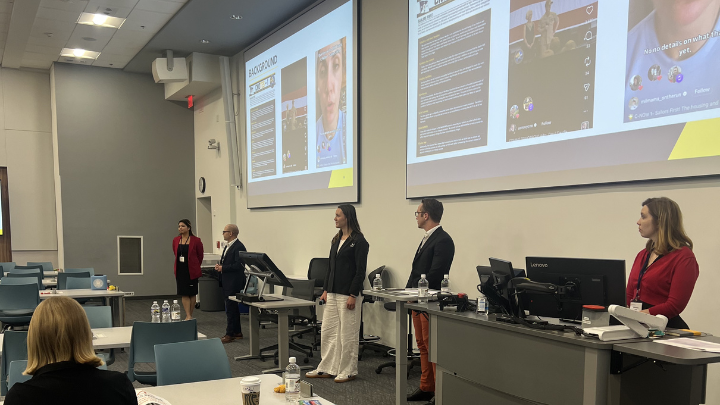
In a lecture hall filled with some of the most respected minds in public relations, a group of San Diego State University graduate students stepped forward, not as spectators, but as contributors to the future of the field.
At the Institute for Public Relations Bridge Conference, SDSU’s School of Journalism and Media Studies cohort presented original research tackling some of the industry’s most pressing questions, from the ethics of artificial intelligence to the growing influence of internal voices within organizations.
“They proved their own worth against the best our profession has to offer,” said Dave Oates, a JMS lecturer who accompanied the cohort. “I can’t adequately express my pride […] watching the cohort shine.”
The IPR Bridge Conference is known for its unique format, bringing together leading scholars and communication professionals in an intimate setting designed for collaboration and critical discussion.
Unlike traditional academic conferences, the event emphasizes actionable insights, making it an ideal stage for emerging voices to engage directly with industry leaders.
The topics they tackled reflected the evolving challenges of modern communication. One team examined whether there is an impact on trust for organizations that use AI-generated images. Another explored the role of “homegrown influencers” and their effectiveness in shaping internal and external messaging.
“At a time when it’s becoming harder to distinguish AI-generated content from authentic content, it felt important to understand how disclosure actually affects audience perceptions,” Miraquel Ridenhour, one of the student presenters, said.
Ridenhour, who has nearly a decade of experience in public relations, described the experience as both validating and eye-opening. Coming from a professional background, she said the conference helped her connect real-world practice with academic research in a way that felt “intentional and informed.”
The collaborative nature of the cohort also played a critical role in their success. “It always felt like we were moving through the process together,” Ridenhour said. “We knew each other’s strengths and built the presentation around that.”
For students like Jenna Fee Feyerabend, the conference offered not only a platform to present research but also an opportunity to reflect on the broader direction of the industry.
“One of the most impactful insights I gained was that we need to teach people how to use AI in a meaningful and ethical way,” Feyerabend said. “Instead of prohibiting it, we should guide its use to enhance our work.”
Beyond the presentations, the networking opportunities proved equally impactful. Students connected with researchers and practitioners from across the country, exchanging ideas and building relationships that could shape their future careers.
“Our conversations were both friendly and informative,” Feyerabend said. “I connected with several people on LinkedIn and look forward to potential collaborations.”
For Oates, experiences like IPR Bridge are essential in preparing students for the realities of the profession. By taking their work beyond the classroom and into a public, professional setting, students gain a clearer understanding of the impact their research can have.
The experience also pushed students outside their comfort zones, challenging them to present complex ideas with clarity and confidence in front of high-level audiences.
For many, that challenge became a turning point.
“I am confident in my interest in public relations,” Feyerabend said, “but this experience also made me think more deeply about work-life balance and the kind of environment I want to be part of.”
Next Story
SDSU PAO students earn first-ever Bernays Award
JMS MA students earned their program’s first Bernays Award by developing and presenting a data-driven PR campaign, applying their professional experience to create meaningful real-world impact.